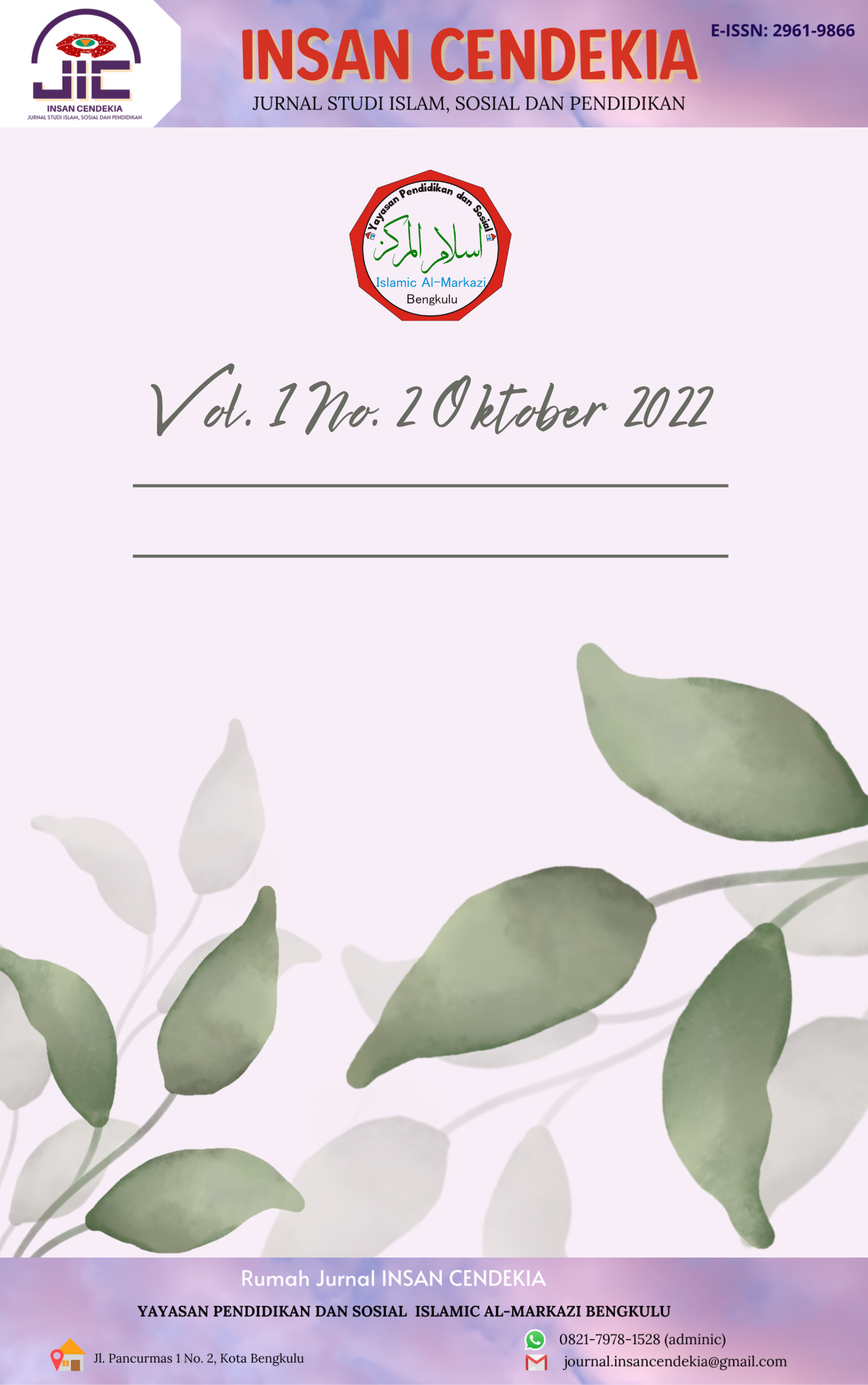
PENTINGNYA SEX EDUCATION PADA SISWA DI KELAS TINGGI SEKOLAH DASAR (PERSEPSI & PERAN GURU)
DOI:
https://doi.org/10.67528/ic.v1i2.94Keywords:
Pendidikan Seks, Siswa Kelas Tinggi, Siswa Sekolah DasarAbstract
Penelitian ini dilatar belakangi oleh banyaknya pelecehan seksual dan kekerasan seksual terhadap anak di berbagai penjuru tanah air serta minimnya pengetahuan masyarakat mengenai pentingnya pendidikan seks diberikan pada anak. Sehingga tujuan penelitian ini difokuskan untuk mengetahui persepsi guru pada siswa kelas tinggi di Sekolah Dasar (SD). Studi ini menggunakan metode deskriptif kualitatif dengan teknik pengumpulan data menggunakan observsi, wawancara dan dokumentasi. Dari hasil penelitian dan analisis data maka dapat disimpulkan bahwa persepsi guru telah mempunyai pemahaman yang cukup relatif memadai terkait dengan pendefinisian pendidikan seks kemudian persepsi bahwa pendidikan seks bagi anak penting dan seharusnya diajarkan hanya saja terdapat perbedaan pendapat mengenai tujuan dan target yang diinginkan dari pendidikan seks tersebut dan faktor pemicu maraknya terjadi pelecehan seksual dan kekerasan seksual pada anak dan terdapat faktor penghambat guru dalam memberikan pendidikan seks pada anak.
References
Anggito, A., & Setiawan, J. (2018). Metodologi penelitian kualitatif. Sukabumi: CV Jejak (Jejak Publisher).
Astari, A. R. N. (2021). Analisis Faktor Internal dan Faktor Eksternal Pengorganisasian Dalam Lembaga Pendidikan Islam. Al-Khair Journal: Management, Education, And Law, 1(1), 30-39.
Fadli, M. R. (2021). Memahami desain metode penelitian kualitatif. Humanika, Kajian Ilmiah Mata Kuliah Umum, 21(1), 33-54
Harmita, D., Nurbika, D., & Asiyah, A. (2022). Keteladanan Guru Pendidikan Agama Islam dalam Internalisasi Nilai-Nilai Akhlakul Karimah pada Siswa. JOEAI: Journal of Education and Instruction, 5(1), 114-122
Komnas Perempuan. 2020. Catatan Tahunan Kerkerasan terhadap Perempuan. Jakarta: Komnas Perempuan
Magta, M., & Lestari, N. G. A. M. Y. (2022). Analisis Efektivitas Pelatihan Pembuatan Media Pendidikan Seksual Bagi Anak Usia Dini. WIDYA LAKSANA, 11(2)
Mashabi, Sania. 2020.Kementerian PPPA: Sejak Januari hingga Juli 2020 Ada 2.556 Anak Korban Kekerasan Seksual. Kompas, 24 Agustus 2020.
Mustofa, Bisri. Kekerasan Seksual pada Anak di Bengkulu Capai 105 Kasus. Antara Bengkulu, 4 September 2020
Nadar, W. (2018). Persepsi orang tua mengenai pendidikan seks untuk anak usia dini. Yaa Bunayya: Jurnal Pendidikan Anak Usia Dini, 1(2), 77-90
Noormalasarie, N. (2017). Konsepsi Al Quran tentang Pendidikan Seks pada anak. Lentera: Jurnal Ilmiah Kependidikan, 12(2)
Rahmanita, U., & Khairiah, K. (2022). Model Pembelajaran Edutainment Dalam Meningkatkan Motivasi Belajar Anak Usia Dini. Al-Khair Journal: Management, Education, And Law, 2(1), 12-21.
Satori, D., Komariah, A., & Suryana, A. (2019). Character education in the era of industrial revolution 4.0 and its relevance to the high school learning transformation process. Utopia Y Praxis Latinoamericana, 24(5), 327-340
Sirajuddin, M. (2012). Kecenderungan Pendekatan Pembelajaran Fikih di STAIN Bengkulu. INFERENSI: Jurnal Penelitian Sosial Keagamaan, 6(2), 301-324
Tantimin, T. (2022). Polemik Meningkatnya Perkawinan Anak: Realitas Dan Pencegahannya. Maleo Law Journal, 6(1), 15-29
Wardah, Fathiyah 2020. Lebih 4.600 Anakalami Kekerasan Tahun 2020. VOA Indonesia, 28 Juli 2020
Wathoni, K. (2016). Persepsi guru madrasah ibtidaiyah tentang pendidikan seks bagi anak (Studi kasus di MI se-Kecamatan Mlarak). Kodifikasia, 10(1), 144897
Downloads
Published
Issue
Section
License
Copyright (c) 2025 M. Arif Rahman Hakim, Witha Putridianti, Deni Febrini, Ade Riska Nur Astari

This work is licensed under a Creative Commons Attribution-ShareAlike 4.0 International License.
LICENSE TO PUBLISH:
1. License
Authors who publish with Insan Cendekia agree to the following terms: Authors retain copyright and grant the Insan Cendekia right of first publication with the work simultaneously licensed under the Creative Commons Attribution-ShareAlike 4.0 International (CC BY-SA 4.0) license, that allows others to share (copy and redistribute the material in any medium or format) and adapt (remix, transform, and build upon the material) the work for any purpose, even commercially with an acknowledgement of the work's authorship and initial publication in Insan Cendekia.
2. Author’s Warranties
The author warrants that the article is original, written by stated author/s, has not been published before, contains no unlawful statements, does not infringe the rights of others, is subject to copyright that is vested exclusively in the author and free of any third party rights, and that any necessary written permissions to quote from other sources have been obtained by the author/s.
3. User Rights
Under the Creative Commons Attribution license, the author(s) and users are free to share (copy, distribute and transmit the contribution).
4. Rights of Authors
Authors retain the following rights:
- copyright, and other proprietary rights relating to the article, such as patent rights,
- the right to use the substance of the article in future own works, including lectures and books,
- the right to reproduce the article for own purposes, provided the copies are not offered for sale,
- the right to self-archive the article.
5. Co-Authorship
If the article was prepared jointly with other authors, the signatory of this form warrants that he/she has been authorized by all co-authors to sign this agreement on their behalf, and agrees to inform his/her co-authors of the terms of this agreement.
6. Termination
This agreement can be terminated by the author or Insan Cendekia upon two months’ notice where the other party has materially breached this agreement and failed to remedy such breach within a month of being given the terminating party’s notice requesting such breach to be remedied. No breach or violation of this agreement will cause this agreement or any license granted in it to terminate automatically or affect the definition of Insan Cendekia.
7. Royalties
This agreement entitles the author to no royalties or other fees. To such extent as legally permissible, the author waives his or her right to collect royalties relative to the article in respect of any use of the article by Insan Cendekia or its sublicensee.
8. Miscellaneous
The Insan Cendekia will publish the article, or arrange for its publication, provided that the editorial process is successfully completed and the journal or its sublicensee becomes obligated to publish the article. The Insan Cendekia reserves the right to edit the article for consistency in punctuation, spelling, capitalization, and style, as deemed appropriate.